Friday

How to survive a slasher film.

The last time I hung out with Wes Craven, he was kind enough to share his thoughts on the philosophy of the slasher film.

One of the things he said was that the genre was about morality: only the most morally pure teen would not only survive, but vanquish the slasher. Vanity, greed, sloth, and particularly lust were the distractions that turned all the other teens into victims. 

I know. Simple, right?

Naturally, I decided to flip the notion on its head. I wrote a script –– a coming-of-age-as-a-slasher flick –– the premise of which was that only the most morally impure slasher would survive and vanquish the teens. It’s probably the strongest film I’ve written, so thank you, Wes.

The reason I mention all this is that I was issued a challenge by Alexandra at Man Crates, a company that ships gifts for men in custom wooden crates that have to be opened with a crowbar. She wanted to know what I’d want in a crate in order to survive a horror movie I found myself trapped in. 

You know where I’m going with this, right?

If I’m trapped in a slasher film, it’s a pretty safe bet I’m not one of the teens. At my advanced age, I’m more likely going to be the slasher. So here’s what I’d need:

  1. Music. Killing, like editing, depends on rhythm. I’ll take boxed sets of Zepplin, Stones, and AC/DC, preloaded onto an iPod Shuffle (Product Red, of course) because the battery is going on the one I have. 
  2. Polyester clothing. You know what a bitch it is to get blood stains out of the pima cotton and wool blends I normally wear? While you’re at it, throw in one of those jumbo-sized jugs of Tide, the kind with enzymes in it. 
  3. A good knife. I’m partial to the Misono UX10 Gyuto 240mm, but I could make do with a Shun Premier 10”. Wusthoffs have great handles but you really give up a lot of blade flexibility.
  4. Coffee. Slasher films take place at night and I gotta stay awake. Lately, my brew of choice is Extracto Guatemala San Pedro Necta. 
  5. A buddy. I know slashers work alone, but this is my story and I think a slasher buddy movie would be more interesting. Jack Black would be fun, but of course he’d probably end up turning on me at the end. How about Steve Carell? I bet he would die well.
  6. A good motivation. Sorry, but so many slasher films fail here. Why? Why do I want to kill all those young, beautiful people who have no concept of mortality or morality and who spend disproportionate minutes of screen time taking showers, getting wasted, and having sex… Um, never mind. 
One last thing. A crow bar. 

Oh, and Alex? Send it separately. And first. 

Monday

Not about film. Not about advertising. This post is about the future.


Ophelia Belefant, Founder and Curator of The Heart Show
Last year, my daughter, who was in kinder-garten, heard about kids whose hearts needed to be fixed. It was part of a presentation for a fundraiser –– kids would jump rope to raise money for the American Heart Association.

She was really affected, but she didn’t know how to jump rope. If she couldn’t jump rope, what could she do, I asked? She thought for a moment and then said she could make a painting and sell it.

I tend to be a big thinker, so I prodded her to think about how she could do even more. What she came up with was an art show.

She invited all the kids in her class to participate. I got canvasses and paints for everyone, and asked my favorite local patisserie to let us take over for three hours one afternoon. I made up forms for a silent auction. Then I called up the hospital where she was born –– which has a highly regarded pediatric cardiology unit –– and told them what we were up to. The executive director of the foundation came to the show and accepted the donations from the kids.

Long story short, the kids raised $375.

More important, they realized that their efforts could generate immediate results.

And my daughter got to see first hand that the first two steps toward accomplishing anything are figuring out what you want to do and then believing that it’s possible.

My daughter is putting on the show again this year. And my son, who’s in kindergarten himself –– is inviting his classmates to join in, too. That means twice as many artists and hopefully, twice as much money raised for pediatric cardiology.

A radio station found out about the show and interviewed my daughter, too, so maybe we’ll get even better attendance than parents and friends.
Your very own invitation. Please come.

So here comes the ask:

My kids have identified something worthwhile that they want to contribute to. If you like the sounds of it, we sure would appreciate it if you’d help.

The show is in Portland, Oregon on Wednesday. Come by if you can. We’ll have a silent auction where the highest bidders will bring home some stunning art created by five- and six- and seven-year-olds.

I created a Facebook event where you can find out more information, see the masterpieces (once I photograph them all), and download an invitation you can forward to friends, members of the press, and art collectors you know.

https://www.facebook.com/events/592990744114266

If you can’t make it, consider writing a check to the Randall Children’s Hospital. Put “The Heart Show” on the memo line, so whatever you give will add to what the kids bring in. Here's the address: 2801 N Gantenbein Ave, Portland, OR 97227

These kids –– all kids –– are the future. And this is why I’m so passionate about what my daughter and son and their classmates are doing. I sincerely hope that all of them come to believe that good can be done and that they can be the ones doing good. Not just the kids putting on the show, but also the ones benefiting from the money raised.

Thank you.

Wednesday

The second greatest birthday present I ever received and I’m going to share it with you!

Three years ago, my children –– who were two and a half and four at the time –– decided that the perfect birthday present for me was a chicken costume.

I’m not making this up. 

They came up with this idea all by their precious little selves, in spite of all the exposure they'd had to mass produced coffee mugs and ties emblazoned with the words “World’s Greatest Dad.” 

My kids are a lot like me in that when they know something is great, they won’t settle for pretty good. They knew they'd come up with the perfect present and they made my then wife drive all the way to Beaverton to find one that they could give me. No birthday present before or since could possibly give me as much joy. 

Only one came close. And you know what’s weird? I got it the same year. 

But before I can share it with you, I have to give you a little backstory. 

Back in the 1970s and 80s, Ed McCabe was heralded as one of, if not the greatest copywriter ever in the history of advertising. He created legendary ads for Volvo, Perdue, Nikon, Cutty Sark, and a bunch of other brands. And I had the incredible good fortune to work for him. 
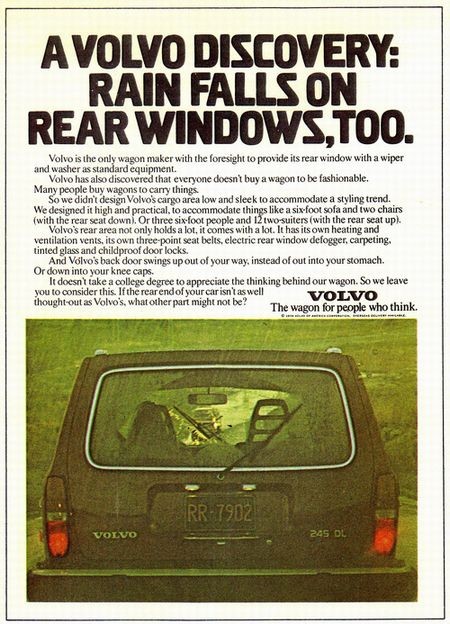
An ad Ed did in 1973. Makes you feel like
a schmuck for not buying a Volvo, doesn't it?
You weren't hired to work for Ed, you were chosen. And we who had been chosen went to a lot of trouble to be sure we were worthy of the grace we had received. We behaved more like acolytes than employees, studying the Gospel According To Ed and exhorting those who weren’t pure of faith to see the light, quoting him the way young Chinese communists used to quote Chairman Mao.

“A good ad makes you feel like a schmuck for not buying the product.” was one of my favorites.

I found great solace in Ed’s wise teachings. One passage, “If you need an exclamation point, you need a new sentence,” I took to heart, vowing that that I would never, as long as advertising would have me, ever use an exclamation point. Ever. It was a vow of celibacy, sort of, and I even popped the 1 key off the electric typewriter the agency had issued me because as any votary can attest, the best way to resist temptation is to remove it, never mind that a lot of what I was called to write was coupon ads for toilet paper and it's kind of hard to type "Save 10¢" without a 1 key. 

Over the years I've found that there were other ways to be righteous in advertising and my position on some of Ed’s edicts softened. I came to understand that a good ad doesn't have to make you feel like a schmuck after all, although I still maintain that it does have to make you feel. But god damn it, I held onto that exclamation point rule. 

In retrospect, I was like a carpenter who refused, on principal, to use needle nose pliers, even once in a while when you couldn’t get the claw end of a hammer into that tiny space up under the eaves to remove a staple from the old siding because Jesus said not to use them, never mind that Jesus probably wasn’t the kind of carpenter who had call to renovate a Portland four square.

Back to my birthday.

You know how kids are. They pile on top of you, get all excited to give you the best birthday present in the history of birthday presents, and then suddenly they’re off making an art project out of dust bunnies while you sit there, wondering whether it’s okay to take the chicken costume off now because it makes your nose sweaty. If you’re me, you do. And then you log onto Facebook in hopes of finding something, anything, that will prolong the incredible birthday love rush.

And there it was. A birthday greeting. Three words: 

Happy birthday, Brian!

From Ed. 

McCabe.

I try not to swear when the kids are around but I’m pretty sure I used the F word. That’s okay, though, because dust bunny art requires intense concentration and they probably didn’t even notice.

To say this was a big deal was kind of an understatement. This was a  big deal!

Sure, advertising and I and probably even Ed had changed a huge amount in since I wrote coupon ads at Scali, and sure, I’d reconsidered a lot of what I learned from him as I progressed in my career, but when I came to actually putting into practice something Ed specifically told us –– told me –– not to do, I always felt like I was kind of betraying the guy. Like I'd need to be ready with an explanation in case he picked up the phone and called me on it

Here was Ed himself telling me that it was okay. 

That was three years ago today. Today, on the anniversary of that birthday, I want to give the gift to you. 

If you shared my obligation to avoid exclamation points, I hereby release you. Let it go. 

Not because I said it's okay or even because Ed said it's okay, but simply because we are in the business of communicating and the reason we have rules at all is to guide us, not constrain us. 

The point is, do what works. And by the way, a really good way to figure out what works is to know your audience and genuinely care about them. I gotta believe that's what got my kids to come up with the chicken costume in the first place.

Tuesday

I have a problem and it involves John Cleese and a camel.


Back when I was first getting into directing, I heard John Cleese interviewed on the radio and he said something incredibly profound. something that helped me to become a better director. A much better director.

Here’s the problem: I can’t find the quote.

I've done Google searches on every version of what I think he might have said and I came up with nothing (although –– kind of random –– I did stumble onto a quote by Henri de Toulouse-Lautrec that made me laugh out loud).

As far as I know, it might not have been John Cleese who said it. Hell, it might not have even been said, which would be kind of Charlie Kaufman-esque when you think about it, how my understanding of comedy was informed by a quote that was never actually uttered and that somehow, I'm convinced I got to be a better director because of it.

Doesn’t matter. I believe it to be true. And that brings me to the camel.

Watch this spot which you've already seen:

Screen Shot 2014-01-04 at 10.37.07 PM

Ask people what the spot is about and they'll tell you it's about a camel that's happy it's Wednesday. Which it is. Only it's more. It's about a camel that's always happy it's Wednesday.

And how do we know that? The camel's office mates.

The camel is funny. Great voice. Perfect performance. Beautiful visual effects. But what's truly funny is that even though it might be our first time hearing him go on about hump day, it's their millionth.

That's what makes this spot work. So well that according to AdWeek, this spot was one of the ten most watched commercials of 2013.

And here's where I finally let you in on you what John Cleese may or may not have told me: People's reactions to something funny almost always make the funny thing funnier.

Take away the coworkers and this spot wouldn't have sucked. But it wouldn't have been nearly as good.

John Cleese knows this. I know this. And now you know this, too.

If I were wearing a hat, I'd be tipping it right now to the Martin Agency and the creative team there who worked on it (the spot, not the hat): Joe Alexander, Steve Bassett (who I used to work with back at Chiat and who is truly one of the most courteous people in advertising), Wade Alger, Sean Riley, Ken Marcus, Molly Souter, Samantha Tucker, and Emily Taylor.

But mostly I'd be tipping it to Wayne McClammy, the director. For seeing what the spot could be and letting it be just that.

Monday

My Christmas gift to you: Three secrets to making a great commercial

Good ad agencies, like good businesses of any ilk, have a point of view. And back in the 90s, BBDO was one of the best. Their point of view enabled them to do a particular kind of advertising and they did the shit out of it for Pepsi, Visa, Skippy, and Frito-Lay.

I know this well because from 1993 to 1995 I was Senior Vice President/Creative Director at BBDO.

I'm going to tell you a secret. The BBDO secret.

The quintessential BBDO commercial (the agency almost exclusively did TV commercials) relied on three things: 1) Intrigue, 2) Misdirection, and 3) Making the product the hero.

Intrigue means it's a story and the story sucks you in.


I wonder what's going to happen next, don't you? You do. We all do, especially since we establish that two boys are watching her. (Remind me to share John Cleese's brilliant observation about comedy in a post someday.)

Misdirection goes to the dramatic structure. If you know how your story is going to turn out, why would you continue watching? Well, yeah, there are reasons. Like, for instance, it's Cindy Crawford. 

Sure, we know Cindy is going to put money into the vending machine and push a button. Will a Pepsi come out? It does. Will she drink it? She will. But what of the two boys?

Here comes the misdirection: As Cindy slugs down the Pepsi, the two boys watch, slack jawed. One of them comments, "Is that a great new Pepsi can or what?"

Which brings me to making the product the hero. That's shorthand for "the product is not just integral to the story, it is the very thing that makes the punch line satisfying." When your product isn't the hero, you may have something funny –– like shooting gerbils out of a cannon as Outpost.com did in a Superbowl spot back in 1999 –– but you don't really have a commercial.

The hero of the spot with Cindy Crawford is the can. Pepsi had redesigned their can. Implicit in the commercial, whether believable or not, was that Pepsi's new can was even more beautiful than Cindy Crawford's... well... can.

It's twenty years later and the same approach still works magic. A magnificent example is Apple's "Misunderstood" holiday commercial.

We think we're watching a kid playing with his iPhone at the expense of engaging with his family during the holidays. Misdirection. Turns out he's shooting a movie of the family on his iPhone to share with them on Christmas morning. 

As for product as hero, yep. Apple made a big point about its improved video capabilities with the introduction of the new iPhone earlier this year. I'm pretty sure the brief the agency worked from directed them to create a spot that highlighted the feature.

Feature.

That's an important word and it brings me to Secret #4. (I know. Look at me being all generous.) There are features and there are benefits. Features are what a product has or does. Benefits are what you get from having a feature. The ability to make a movie on your phone is a feature. The ability to bring your family together and share memories almost as they're being created? That's a benefit.


This is an extraordinary spot. Beautifully conceived and well-crafted.

I'm grateful to both Apple and TBWA\Chiat\Day (the ad agency) for giving me a gift I so appreciate as this most difficult of all years finally comes to a close: Proof that it's still possible to create truly great advertising.

I'm entering 2014 inspired. I hope you are, too.

Wednesday

Sometimes the only way you can tell something is art is because it was made by an artist.


How's the weather up there, Mr. Lincoln?
Did you see 'Lincoln'? Go see it. 

Not the whole thing. The first five minutes will do. Go ahead. I'll be here when you get back.

Okay. Notice anything… funny? I'll give you a hint. It's the scene at the beginning, where Lincoln (Daniel Day-Lewis) is talking to the soldiers. Lincoln is sitting on a covered platform; the soldiers are standing on muddy ground. Tents are pitched around them. Campfires burn.

When we're looking at Lincoln, it's raining. Hard. That backlight thing Steven Spielberg likes so much –– with shafts of light that illuminate the weather –– makes it impossible not to notice. But when we're looking at the soldiers Lincoln is talking to –– same time, same conversation –– nary a drop is falling.

It's tempting to call this a mistake. It isn't. 

It's not a mistake because while in real life, we have to put up with whatever weather we're given, as directors we get to make whatever weather we want. 

If we want rain –– even if the forecast calls for a 90% chance –– we bring in water trucks and hire crew members to build and operate the rigging necessary to make it look natural. 

If we don't want rain it's a little easier. It takes a serious downpour to register as rain on film. Still, if there's money in the budget and we're not shooting in Southern California, we bring in tarps or silks and rigging and hire crew members to build and secure the rigging and light through and/or around it. 

That's what we do. We make daytime look like night, winter look like summer, and sunny look like cloudy. 

This goes a long way toward explaining why movies are so damn expensive to make. 

When the UPM and the Assistant Director (Susan McNamara and Adam Somner) broke down the script for 'Lincoln' with Spielberg, they went through every single scene and asked Mr. Spielberg, among other things, whether he wanted any special weather effects. That's their job.

It’s the UPM’s job because it affects the budget. Rain takes trucks and water and rigs and all sorts of ancillary characters that need to be added to the number of people to be wrangled and fed and provided parking spots and restroom facilities on that day. It’s the AD’s job because it affects both the shooting schedule and the safety of the crew members and actors. The three of them have more than 100 films under their collective belts. This ain’t none of them's first rodeo.

Then there's the script supervisor whose job it is to make sure that continuity is maintained. When Anna Rane showed up on the day they shot that scene, she would have asked Mr. Spielberg if he was sure the scene was going to cut, what with rain when the camera was pointing in one direction and no rain in the other. You don't get to be script supervisor for Steven Spielberg by letting huge continuity lapses happen. 

And don't forget the crew. As in the entire crew. The gaffers who lit the scene. The grips who rigged it. Maybe they didn't all notice, but I'll bet some did. I guarantee you Ryan Cole did. He's the sound recordist who had to fight the sound of the rain in one shot and didn't have to deal with it in the reverse. 

I figure one of two things happened here: Either a) somebody made an announcement to the entire crew that yes, they knew the rain gag was going to be inconsistent, but that's what they were going for or b) Spielberg had to contend with a relentless parade of helpful people pointing out to him that they were shooting rain when there wasn't rain before or that they weren't shooting rain when there was rain before. 

I mean, seriously, if you were one of the more than 60 production assistants on this show –– even if it was your first time stepping onto a film set –– wouldn't you go out of your way to be helpful in hopes that you’ll impress someone enough be invited to the next one or get promoted to a better, higher-paying job?

No, I'm certain this scene was shot just the way Spielberg intended it to be. And it must have worked for the members of the Academy, too, because he got nominated for Best Director.

All of this is leading up to a point and the point is this: I don't get it.

I don't get what he was going for. I don't understand why you'd shoot a scene that is so clearly discontinuous. 

I suppose it's art. To me, it smells a lot like Kool-Aid.

Monday

Hey, John Lasseter, my six-year-old has some choice words about the dialogue in your latest film.


Let me start by saying that John Lasseter is truly one of the greatest filmmakers alive. His oeuvre is dominated by sophisticated explorations of the father figure as an archetype, particularly with regard to redefining his identity in a world that shifts beneath him.

I never hesitate to take my kids to any film John Lasseter is associated with, and if you're getting the impression I'm raising film snobs, well, yeah. I guess I am. Film snobs who can differentiate between a Pixar film and a Dreamworks film. 

Did I mention they're five and six?

Yep, at five and six my kids appreciate structure, character development, performance, and theme, just like any ordinary five- and six-year-olds –– who happen to have a father who can't help but encourage them to identify what works for them and what doesn't. 

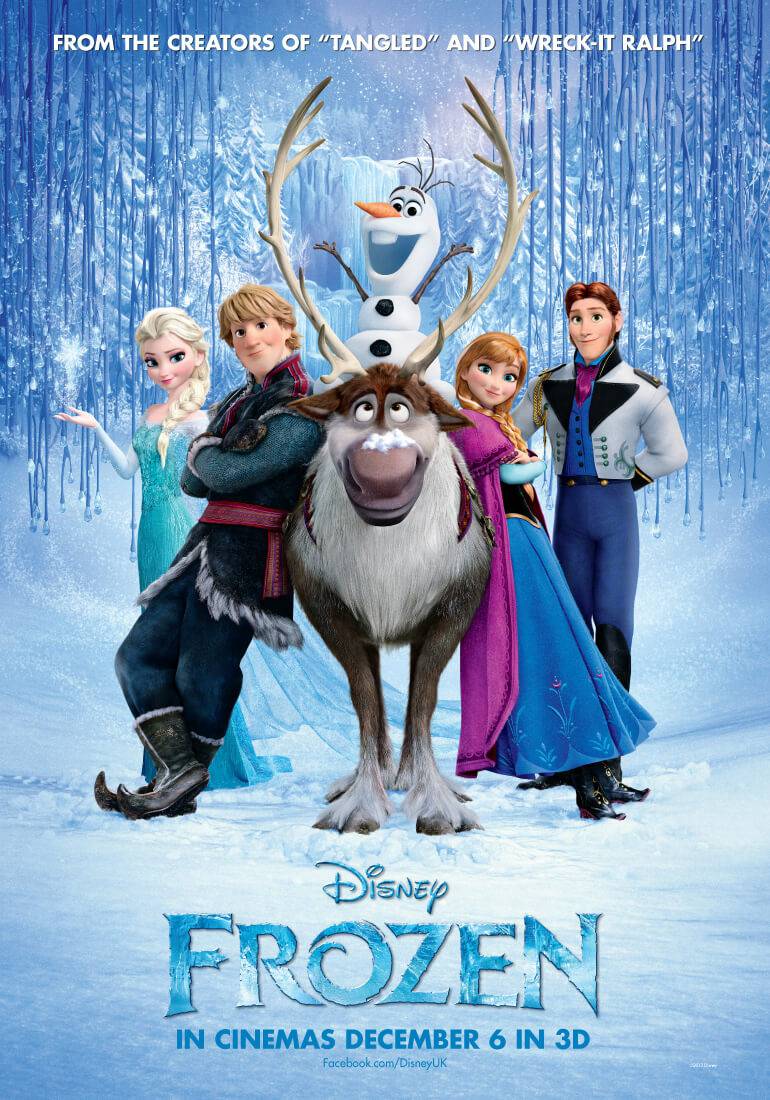
So of course I took my precious little film critics to see 'Frozen'.

I'm not going to do a movie review here, other than to say that except for the tight structure, engaging characters, clever dialogue, and thoughtfully crafted world the story takes place in, you'd never know John Lasseter had anything to do with 'Frozen'. The story is entirely devoid of a father figure. 

More than once, a bit of unexpected dialogue made me laugh out loud. But then, halfway through the third act, the good guy says to the bad guy, "You'll never get away with this." The bad guy replies, "I already have."

My six-year-old daughter leaned over and said, "Dada, we already heard that line in something else."

She was right. We had. (Three days before we'd watched 'Escape from Planet Earth', which in an interesting bit of irony is not a John Lasseter movie at all and yet is –– you guessed it –– an exploration of the father figure as an archetype, particularly with regard to redefining his identity in a world that shifts beneath him. Go Weinsteins, right?)

To be fair, 'Frozen' was actually directed by Chris Buck. John Lasseter was the executive producer. And 'Escape from Planet Earth' was directed by , not Harvey and/or Bob Weinstein. Add to that as far as critical acclaim goes, while John Lassiter has only won two Academy Awards (not counting the two Student Academy Awards he won while at California Institute of the Arts), the Weinsteins have won 75. 

So why am I picking on John Lasseter?

Because he has such a clear, consistent vision. And the power to insure that every single thing that comes out of Walt Disney Animation Studios and Pixar meets his extraordinarily high standards. As for the Weinsteins, while some of the films they've been associated with are transcendent ('Silver Linings Playbook', 'The King's Speech'), some are pretty crappy.

Sorry, John. That's what you get for being so damn good.